

 扫描二维码添加客服微信
 扫描二维码关注
介绍春节的ppt素材英语-英语春节手抄报版面
中国节日的英语PPT
元旦 New Year' s Day Jan.1
国际劳动妇女节 International Working women' s Day (wornen's Day) Mar.8
国际劳动节 nternatlonal Labor Day (May. Day) May.1
中国青年节 Chinese Youth Day May.4
国际儿童节 International Children's Day (Children's Day) June .1
中国共产党诞生纪念日 ( 党的生日) Anniversary of the Foundlng of the ChineseCommunist Party ( the Party' s Birthday) July .1
建军节 Army Day August .1
教师节 Teachers , Day Sept.10
国庆节 National Dey October.1
中国传统节日
春节 the Sprlng Festival ( New Yearls Day of the Chinese lunar calendar) 农历正月初一
元宵节(灯节) the Lantern Festival 农历正月十五
清明节 the Qing Ming Festival 四月五日前后
端午节 the Dragon-Boat Festiva 农历五月初五
中秋节 the MidAutumn Festival (the Moon Festival) 农历八月十五
重阳节 the Double Ninth Festival 农历九月初九
元旦(1月1日)NewYear'sDay
春节(农历一月一日)theSpringFestival
元宵节(农历一月十五日)theLanternFestival
国际劳动妇女节(3月8日)InternationalWorkingWomen'sDay
植树节(3月12日)ArborDay
邮政节(3月20日)PostalDay
世界气象节(3月23日)WorldMeteorologyDay
清明节(4月5日)ChingMingFestival;Tomb-sweepingFestival
国际劳动节(5月1日)InternationalLabourDay
中国青年节(5月4日)ChineseYouthDay
护士节(5月12日)Nurses'Festival
端午节(农历五月初五)theDragonBoatFestival
国际儿童节(6月1日)InternationalChildren'sDay
中国共产党成立纪念日(7月1日)theParty'sBirthday
建军节(8月1日)theArmy'sDay
中秋节(农历八月十五)Mid-autumn(Moon)Festival
教师节(9月10日)Teachers'Day
重阳节(农历九月九日)Double-ninthDay
国庆节(10月1日)NationalDay
除夕(农历十二月三十日)NewYear'sEve
英语春节资料
1.正月十五的元宵滚进二月二龙抬头的锣鼓声中。人们唱戏跳舞迎祥龙,为的是盼个风调雨顺的好年成。之后就是布谷催种,细雨绵绵的季节了。这时的乡村一身才气,大雁翱翔成标题,禾苗舒展成字句,小河延伸成花边,蜂儿蝶儿飞进去,飞进去便成了新春专版的题花……
Fifteenth day of the Lantern Festival roller-February 2-percussion sound of the rise. Ying Xianglong people operas, dance, I hope for a favorable weather is good Ningcheng. Followed by reminders of Bulu, the season of the continuous rain. This time, a Talent Village, Dayan flying into heading Hemiao stretch into words, a stream extends into lace, bee flying into Dieren children, will fly into the feature pages of a spring flower that……
2.贴春联
据说贴春联的习俗,大约始于一千多年前的后蜀时期,这是有史为证的。此外根据《玉烛宝典》,《燕京岁时记》等著作记载,春联的原始形式就是人们所说的“桃符”。
在中国古代神话中,相传有一个鬼域的世界,当中有座山,山上有一棵覆盖三千里的大桃树,树梢上有一只金鸡。每当清晨金鸡长鸣的时候,夜晚出去游荡的鬼魂必赶回鬼域。鬼域的大门坐落在桃树的东北,门边站着两个神人,名叫神荼、郁垒。如果鬼魂在夜间干了伤天害理的事情,神荼、郁垒就会立即发现并将它捉住,用芒苇做的绳子把它捆起来,送去喂虎。因而天下的鬼都畏惧神荼、郁垒。于是民间就用桃木刻成他们的模样,放在自家门口,以避邪防害。后来,人们干脆在桃木板上刻上神荼、郁垒的名字,认为这样做同样可以镇邪去恶。这种桃木板后来就被叫做“桃符”。
到了宋代,人们便开始在桃木板上写对联,一则不失桃木镇邪的意义,二则表达自己美好心愿,三则装饰门户,以求美观。又在象征喜气吉祥的红纸上写对联,新春之际贴在门窗两边,用以表达人们祈求来年福运的美好心愿。
It is said that the custom of paste couplets, some began more than 1,000 years ago Houshu period, it is history as a card. In addition, according to the "candle-Collection," "Yanjing mind at the age of the" writings such as records, the original form of couplets is known as "Zhao Fu."
In the ancient Chinese mythology, there is a Re-cycle Legend has it in the world, there are mountains, hills covered with a large peach trees in 3000, the tree has a golden rooster. Whenever Jinji ringing of the morning, wandering out at night the ghost will return Re-cycle. Re-cycle is located in the door of peach, the northeast, two door gods stand, the name of God荼, Yu barrier. If the ghost in the evening dry day injury victims rationale things, God荼, Yu barrier will be found and it immediately caught by Flemish Reed do rope tied to it, and sent to feed the tiger. Thus the world are afraid of ghosts God荼, Yu barrier. So with civil peachwood etched on their appearance on their own doorstep, to prevent harm evil. Later, people simply peachwood board inscribed in God荼, Yu Lei's name, so that the town can do the same evil to evil. This peachwood plate was later called "Zhao Fu."
By the Song Dynasty, people began to write in peachwood board couplet, a town peachwood evil without losing the meaning of a two express their wishes, three decorative gateway to beautiful. Also at the auspicious symbol of festivity couplet in red paper to write, in the spring of the paste on both sides of the doors and windows for people to pray for the coming year, Fu expressed the good wish of transport.
3.门神
为了祈求一家的福寿康宁,一些地方的人们还保留着贴门神的习惯。据说,大门上贴上两位门神,一切妖魔鬼怪都会望而生畏。在民间,门神是正气和武力的象征,古人认为,相貌出奇的人往往具有神奇的禀性和不凡的本领。他们心地正直善良,捉鬼擒魔是他们的天性和责任,人们所仰慕的捉鬼天师钟馗,即是此种奇形怪相。所以民间的门神永远都怒目圆睁,相貌狰狞,手里拿着各种传统的武器,随时准备同敢于上门来的鬼魅战斗。由于我国民居的大门,通常都是两扇对开,所以门神总是成双成对。
In order to pray for the longevity of a Corning, a number of local people retained the habit of stickers door god. Reportedly, the two door god affixed to the door, and all Jiaomoguiguai will be daunting. Civil, door god is upright and force a symbol of the ancients that looks surprisingly often a magical character and extraordinary ability. They carefully integrity of kindness Zhuogui Qin is the devil and the nature of their responsibilities, admired by the people of Zhuogui tianshic Zhong Kui, that is such a strange strange phase. So people are always Numuyuanzheng door god, looks ferocious, holding various traditional weapons to be ready to dare to come in with the ghosts fighting. Since China's residential doors, which are two off, door god always in pairs.
4.唐朝以后,除了以往的神荼、郁垒二将以外,人们又把秦叔宝和尉迟恭两位唐代武将当作门神。相传,唐太宗生病,听见门外鬼魅呼号,彻夜不得安宁。于是他让这两位将军手持武器立于门旁镇守,第二天夜里就再也没有鬼魅骚扰了。其后,唐太宗让人把这两位将军的形象画下来贴在门上,这一习俗开始在民间广为流传。
After the Tang Dynasty, in addition to the past God荼, Yu will be outside the barrier, and people again Qinshubao Weichigong two Tang Dynasty generals as door god. Legend has it, Taizong illness, heard the call sign outside the ghosts, through the night no peace. So he let the two generals carrying weapons remain guarding the main entrance, the next day no ghosts on the night of the harassment. Subsequently, the two generals Taizong people the image of this painting down affixed to the doors, the practice began in the civil widely circulated.
6.春节是中国的传统节日。它就像西方的圣诞节一样,象征着欢迎新的一年!
The spring festival is the tradition festival in is the same as the christmas day in the west country,which symbols welcoming the new year.
7.在那一天人们欢聚一堂。春节通常是在每年的二月份,有时是在一月份。在那天,家家户户会贴上代表幸运的春联,放爆竹,还要吃饺子呢!除夕夜那天,就像圣诞节前夕那天,家家户户聚在一起吃年夜饭,祝福彼此,并聊聊对新的一年的期望。小孩子呢收到压岁钱作为新年的一份礼物!
It is the day that the families get together.
The spring festival is usually in the February ,sometimes in the spring festival,every family all paste the lucky inscriptions,they fire the cracker,they eat the day before the new year's first day is the new year's eve,same as the christmas eve,all the families get together to have the new year's dinner,wish each other,talk about the wishes about the new children will receive the money given to them as a lunar new year gift.
The Spring Festival is the most important festival for the Chinese people and is when all family members get together, just like Christmas in the West. All people living away from home go back, becoming the busiest time for transportation systems of about half a month from the Spring Festival. Airports, railway stations and long-distance bus stations are crowded with home returnees.
The Spring Festival falls on the 1st day of the 1st lunar month, often one month later than the Gregorian calendar. It originated in the Shang Dynasty (c. 1600 BC-c. 1100 BC) from the people's sacrifice to gods and ancestors at the end of an old year and the beginning of a new one.
Strictly speaking, the Spring Festival starts every year in the early days of the 12th lunar month and will last till the mid 1st lunar month of the next year. Of them, the most important days are Spring Festival Eve and the first three days. The Chinese government now stipulates people have seven days off for the Chinese Lunar New Year.
Many customs accompany the Spring Festival. Some are still followed today, but others have weakened.
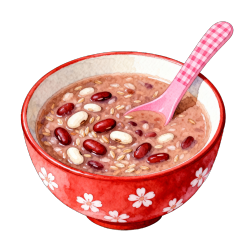
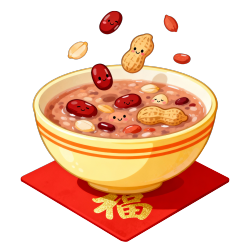
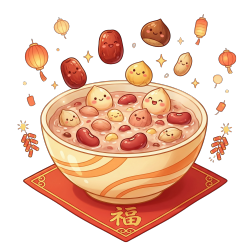
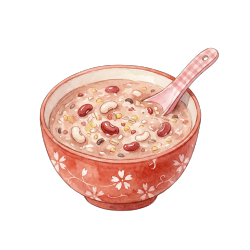
On the 8th day of the 12th lunar month, many families make laba porridge, a delicious kind of porridge made with glutinous rice, millet, seeds of Job's tears, jujube berries, lotus seeds, beans, longan and gingko.
The 23rd day of the 12th lunar month is called Preliminary Eve. At this time, people offer sacrifice to the kitchen god. Now however, most families make delicious food to enjoy themselves.
After the Preliminary Eve, people begin preparing for the coming New Year. This is called "Seeing the New Year in".
Store owners are busy then as everybody goes out to purchase necessities for the New Year. Materials not only include edible oil, rice, flour, chicken, duck, fish and meat, but also fruit, candies and kinds of nuts. What's more, various decorations, new clothes and shoes for the children as well as gifts for the elderly, friends and relatives, are all on the list of purchasing.
Before the New Year comes, the people completely clean the indoors and outdoors of their homes as well as their clothes, bedclothes and all their utensils.
Then people begin decorating their clean rooms featuring an atmosphere of rejoicing and festivity. All the door panels will be pasted with Spring Festival couplets, highlighting Chinese calligraphy with black characters on red paper. The content varies from house owners' wishes for a bright future to good luck for the New Year. Also, pictures of the god of doors and wealth will be posted on front doors to ward off evil spirits and welcome peace and abundance.
The Chinese character "fu" (meaning blessing or happiness) is a must. The character put on paper can be pasted normally or upside down, for in Chinese the "reversed fu" is homophonic with "fu comes", both being pronounced as "fudaole." What's more, two big red lanterns can be raised on both sides of the front door. Red paper-cuttings can be seen on window glass and brightly colored New Year paintings with auspicious meanings may be put on the wall.
People attach great importance to Spring Festival Eve. At that time, all family members eat dinner together. The meal is more luxurious than usual. Dishes such as chicken, fish and bean curd cannot be excluded, for in Chinese, their pronunciations, respectively "ji", "yu" and "doufu," mean auspiciousness, abundance and richness. After the dinner, the whole family will sit together, chatting and watching TV. In recent years, the Spring Festival party broadcast on China Central Television Station (CCTV) is essential entertainment for the Chinese both at home and abroad. According to custom, each family will stay up to see the New Year in.
Waking up on New Year, everybody dresses up. First they extend greetings to their parents. Then each child will get money as a New Year gift, wrapped up in red paper. People in northern China will eat jiaozi, or dumplings, for breakfast, as they think "jiaozi" in sound means "bidding farewell to the old and ushering in the new". Also, the shape of the dumpling is like gold ingot from ancient China. So people eat them and wish for money and treasure.
Southern Chinese eat niangao (New Year cake made of glutinous rice flour) on this occasion, because as a homophone, niangao means "higher and higher, one year after another." The first five days after the Spring Festival are a good time for relatives, friends, and classmates as well as colleagues to exchange greetings, gifts and chat leisurely.
Burning fireworks was once the most typical custom on the Spring Festival. People thought the spluttering sound could help drive away evil spirits. However, such an activity was completely or partially forbidden in big cities once the government took security, noise and pollution factors into consideration. As a replacement, some buy tapes with firecracker sounds to listen to, some break little balloons to get the sound too, while others buy firecracker handicrafts to hang in the living room.
The lively atmosphere not only fills every household, but permeates to streets and lanes. A series of activities such as lion dancing, dragon lantern dancing, lantern festivals and temple fairs will be held for days. The Spring Festival then comes to an end when the Lantern Festival is finished.
China has 56 ethnic groups. Minorities celebrate their Spring Festival almost the same day as the Han people, and they have different customs.
英语春节手抄报版面
英语春节手抄报版面
春节TheSpringFestival
Whenyouaskthepeoplearoundyou,whatisthemostimportantfestivalinChina,Iguess99%ofthepeoplewillsaythesameanswer,,namedNian,,,themonster,Nian,isafraidofthesoundofthefirecrackersandthecolorred;,ourancestorsdecidedthatthefirstlunarcalendardayoftheChineseYearistheSpringFestival.
春节 手抄报 图片
当你问周围的人,什么是中国最重要的节日,我想百分之九十九的人会说出同一个答案,那就是春节。关于春节的由来,还有个古老的故事。一个叫“年”的猛兽,会时不时的袭击人们。为了赶跑猛兽年,人们不得不在旧年的最后一天放鞭炮,在正门和窗户上贴上红纸。幸运的是,年因为害怕鞭炮的'响声和红色的贴纸,不敢再来了。为了纪念这一天,我们的老祖宗把新年农历的第一天定为“春节”。
DuringtheSpringFestival,,apple,noodle,dumplings,poke,chicken,,applestandsfordoingthingssmoothly,noodlestandsforgoodhealthandlonglive,astotheothers,theyallsymbolizefortheluckyandhappinessofthecomingyear.
在春节期间,所有的家庭成员都在除夕的晚上会聚集在一起吃年夜饭。鱼、苹果、面条、饺子、猪肉、鸡肉、糖果是餐桌上必不可少的。“鱼”代表着“年年有余”;“苹果”预示着“做事情平平安安,顺顺利利”;“面条”表示“健康长寿”,至于其他的,表示新年会甜甜蜜蜜有好运气。
ChildrenarethehappiestonesduringtheSpringFestival,,theycandowhatevertheywant,suchastosetoffthefirecrackers,wearnewclothes,usetheirluckymoneytobuythethingstheywant;thisisthebestpartoftheSpringFestival,isn’tit?
小孩子是春节中最高兴的。不仅仅是因为他们多了很多小伙伴,他们还能拿到红包。有了红包,他们可以做任何想做的事情:放鞭炮,买新衣服,买一切想要的东西。对小孩子来说,这就是春节最好的地方了,难道不是吗?
TheSpringFestivalisnotonlymeansthebeginningofthebrand-newyear,butalsocarryingthebestwishofthepeople’s.WearehopingintheNewYearourwishwillcometrue,,themostmeaningfulthingoftheSpringFestivalisthatwespendthetimewiththefamily,thepeopleweloveandweknowthat’sallabout.
春节不仅仅意味着新年的开始,也承载着人们对新年的祝愿。我们希望新的一年愿望会实现,生活变得更好。不管怎么样,春节最有意义的就是阖家团圆,我们与家人一起度过,与我们爱的人一起度过,这就是春节的全部。
素材2:
我的春节MySpringFestival
,,’’,’sDay,,wevisitedtoeachother,bringingourbestwishes.
对中国人来说,春节是一年中最重要的节日。今年,我度过了一个快乐的春节。首先,期末考试我考得很好,这让我的父母非常高兴,他们说这是他们最好的新年礼物。我们回老家和亲人们一起度过了这个春节,除夕夜,我们吃了一顿丰盛的年夜饭,大概有三十个人一起吃饭,非常热闹。晚饭过后,我们一起看了春节联欢晚会。大年初一,我们聚在一起玩游戏、打牌。大人们会给小孩压岁钱,这是最让我们高兴的事。在接下来的几天,我们带上最好的祝福,和亲戚们相互串门
-
 果盘绘画图片大全简单创作方法快速制作技巧
2024-01-02 16:57:54
-
 小年插画图片创作方法快速制作技巧
2024-01-02 16:57:20
-
 小年绘画作品制作技巧
2024-01-02 16:55:45
-
小年插画图片创作方法快速制作技巧
2024-01-02 16:55:02
-
 立春插画图片如何制作
2024-01-02 16:54:19
-
 立春插画图片创作方法快速制作技巧
2024-01-02 16:53:32